We take a look at how the new HTC Sensation stacks up against LG's new Optimus Black We compare the LG Optimus Black to HTC’s Sensation. Form: LG Optimus Black - 122x64x9.2mm...
It's time for HTC's Incredible S to earn its moniker as it goes head-to-head with LG's bank balance friendly super phone, the Optimus Black As the successor to the fantastic Desire HD, the HTC Inc...
A lovely white plastic and silver metal chassis, a smooth 7-inch 1024 x 700 pixel resolution capacitive touchscreen capable of working with special Scribe pen surrounded by a generous black border...
It seems HTC has finally caved to what are likely the security demands of wireless carriers with its newest phones, and is locking down its handsets Moto-style. Latest case in point: the EVO 3D – which sports the same sort of security we found on....
HTC’s first Android Facebook phone, the HTC ChaCha, has been priced and (roughly) dated by UK retailer Carphone Warehouse. The smartphone – which has a 2.6-inch touchscreen, full QWERTY...
Tweet
Google Offers has entered Google’s favorite development stage. Offers beta began today in Portland Oregon, featuring a deal for “$3 for $10 worth of drinks, pastries and treats” at the local chain Floyd’s Coffee shop. The ambitious program, which maybe not so subtly attempts to go toe-to-toe with Groupon, gives users special “offers” at a local store during a certain time period, and according to the new beta site, on a first come, first 2,000 served (for this deal at least).
As we reported at its announcement, Google Offers will support integration with Android phones. We are not sure yet if this will be through a Google Wallet app, or a separate Offers App, but the plan is that you will be able to use NFC on your phone to tap your device at a terminal at the store after saving it to your phone. For now though, Offers and Wallet are not being tested in the same city, so the full extent of the integration to come has yet to be seen.
A note of interest here is Google’s choice to start with a local store. Floyd’s Coffee, is a small family owned coffee shop, with only two stores. It would appear Google is trying to send a message that it will not only be including larger businesses, such as the initial partners it announced for Google Wallet, but plans on having “Offers” for local mom and pop stores as well. It appears Google has big plans for its latest NFC pet projects. Are you sold on the idea of carrying your life in your phone? (more than you already do that is…)
[via Google Offers]
Well people the internet over were skeptical. I personally wanted it to be true, but it turns out that the supposed leaked image of the Nexus 3 was indeed a fake. As several people have noticed, there do appear to be signs on the image which would tend to indicate a photoshop job. The site responsible for the leak has apologized and explained that their source, whom they believed to be a Google employee, was in fact not. It was fun while it lasted, now we go back to awaiting the real Nexus 3.
It was a weak link from the beginning, and now the evidence proves hands down the leak was always a fake. TechHog had several photo experts confirm that the image had indeed been fabricated, as many suspected. Adding to the certainty was a non-responsive source, who it turns out was the one who requested TechHog pull the info and image from the site. I can’t imagine what so motivated this guy to fake a leak anonymously, but he clearly put some thought into it.
The image above is the supposed source of the fake leak. We aren’t sure what this phone is, but it bears a resemblance to several previous HTC phones, appearing to be a metallic version of the Sensation, or the Incredible S. A key thing to notice is that the image above, still has the usual extra bezel space for hardware buttons, even though they are not visible, further strengthening the link to the Incredible S and its rotating capacitive buttons. We’ll keep you updated if anymore details about this phone, or the Nexus 3 comes to light.
[via TechHog]
Tweet
Like everything in the mobile world, new ideas are often met with praise and jubilation by some, and criticism and detest from others. However, Google Wallet has taken tech sites by storm; way more than usual. In fact, the general idea about it is that it will fail. Sites are making claims such as “it won’t catch on,” “it’s horribly insecure,” and “it’s dead before it’s started.” As an author of a tech website, I’m flabbergasted. Since when was it our job to try to convince people NOT to try great new products? Every writer knows that by criticizing something you’ll get more page views. That’s all fine and dandy, but Google Wallet IS a good product. People should be excited about the possibilities, not afraid to get a phone with NFC because some tech blogs are calling it the devil. So I’m here to shoot down their claims and make my bold prediction. Google Wallet will not only succeed, it will take the world by storm. Crazy I know, but I have my reasons.
Google Wallet won’t catch on because: 1) It’s not secure enough
The argument here is that people won’t trust using their phone as a credit card. That “they won’t want to have all that information on something that can be stolen.” Did no one take the time to think about the fact that your actual credit card can be stolen? Based on requiring a separate PIN just to use the Google Wallet app, you could actually make an argument that perhaps Google Wallet is more secure than your actual credit card. You wouldn’t want either of them stolen. Believe it or not, the same case was made against credit cards when they first came out. Guess what? Based on my highly scientific observations people don’t give a crap that credit cards are less secure than checks or carrying around a designated amount of cash. People like ease of use. And that’s something that Google Wallet gives people. If you steal a credit card you need a PIN to use it. Same with Google Wallet. All I see is one less thing you’re carrying (sorry credit card, you’ll always have a special place in my heart). 2) All your information on software means it can be hacked
This is true. There will eventually be someone who can hack Google’s app and get at your credit card info. Hackers are pretty good now a days. The problem with this proving that Google Wallet will fail is that this already happens in the real world. How many of you have done taxes online? Managed your bank account online? Believe it or not, there was a lot of criticism that those sites wouldn’t be as secure as doing it by hand or by going into your nearest bank. There is malware out there that actually steals the info you put on those sites. Do you want to know why those sites and online banking are still successful? There’s two reasons. Going back to what I said earlier, the first is ease of use. People like being lazy. Yes, it’s not as secure as traveling to your bank, but I’d much rather walk 10 seconds to my office than drive 10 minutes to my bank. Secondly, you’d have to be a fool to think companies aren’t aware of these. They know that if a wide spread hack makes their website seem insecure in the public eye they’ll go out of business. Because of this those companies put a great deal of effort into securing these sites. They constantly update them, scan for hacks, watch the internet for word of these hacks, and change how their website works so by the time hackers develop a way that way no longer works. Google will do the same thing. Google is one of the most advanced technological giants of our age. Do you think they’ll just encrypt something willy nilly and throw it to the wolves? I don’t think so.
Bonus point: PSN was hacked, and hundreds of thousands of peoples’ credit card information got out to the world. People are still going to go back on PSN, I promise. They trust Sony to fix this and be secure. Google is often held in an even higher light than Sony when it comes to security. Something tells me people aren’t too worried about this. 3) It won’t catch on
Neither will an expensive MP3 player, wifi, “4G,” Blu Ray, Android phones, or Tablets. All of these ideas were shot down by analysts because “they weren’t adopted by enough people,” or they had “better versions in the works already.” My point here is that the biggest tech company our generation has seen since Microsoft is backing up an idea they created. It WILL succeed. NFC is already huge in Japan (go figure), so people like it. It’s a tried and true formula that Google has watched and tested in other markets. Sure, not too many vendors right now have means to accept Google Wallet, but they eventually will. In the beginning, not too many devices were equipped to connect to WiFi networks. In the beginning not too many artists were keen about putting their music on iTunes for sale. In the beginning few companies wanted to invest into Android Phones because the iPhone was too dominant. The fact of the matter is good ideas catch on. Companies will look at Google Wallet as a way of making sure every customer can pay for their services. At some point in the future, managers at stores around the nation will realize that if their stores don’t have NFC capabilities some people won’t be able to pay at their store. That’s bad for business. They’ll make sure that people can pay any way they want to…just so long as they’ll pay (why do you think nearly every credit card is now accepted everywhere? It’s bad for business to be selective).
The fact that NFC is popular elsewhere and is just an alternative way for paying leads me to believe Google Wallet will be a very successful business move by Google. Even more, it’ll make consumers lives even better. Because let’s be honest, no one likes having a fat wallet. They’re just uncomfortable to sit on.
Tweet
Some leaks suck. Your water bill goes up, its a mess, carpet can get ruined. Some leaks are freaking awesome. They reveal new phones, bring us pics of said phones and make me geek out for hours on end! This is the second kind. This, ladies and gentlemen, is the Nexus 3.
This leak, courtesy of a brave soul in the Android Dev Labs, brings us an early look at a prototype of the HTC manufactured 3rd Nexus phone which we expect to launch with Ice Cream Sandwich late this year. Let’s see what we’ve got. First, as you can see above, there is a distinct lack of the usual hardware buttons. Ice Cream Sandwich is supposed to bring Honeycomb UI elements to phones, and it appears this includes the trading of hardware buttons for the action bar. While it is hidden by the thumb, there is also a front facing camera.
While this is obviously not a finished product, especially considering Ice Cream Sandwich is a ways off still, there are still a few more jewels to gleam here. First it was also noted that Google is testing both an HSPA+ and Sprint CDMA version of the phone, indicating we may see the phone’s initial launch be to multiple carriers. Also, since Google’s changed its mind over hero phones before, a la the Xperia Play, we only know that HTC is being considered.
As we draw closer to the end of the year, expect more details and a more solid idea of who will be building the next Nexus. Now if you’ll excuse me, I have a phone to go drool over.
[via TechHog]
Did you know that the Nexus S (both in its original form and its newer 4G state on Sprint) is fully ready to work with NFC mobile payments? Google knows, they built it. Sprint knows, they’re apparently working on a deal with Google right this second to release a mobile payments service on the 26th of May, 2011. This service will, if it’s real, be available for US customers of Sprint Nextel, so says “three people familiar with the matter” to Bloomberg. Three’s better than one, right?
The three mystery sources told Bloomberg the following bit of text, holding nothing back in a whirlwind of yellow and black, with a dust cloud of blue red yellow and green flying behind them!
The service will let consumers with specially equipped phones that run on Google’s Android operating system pay for goods and redeem coupons with their handsets, said the people, who wouldn’t be identified because the plan isn’t public. The technology is available on the Android-powered Nexus S from Sprint, the third-largest US wireless operator.
Google is rolling out so-called near field communication technology, which lets people pay at NFC-equipped cash registers with a flick of their phone, to boost revenue from mobile advertising and discounts.
Of course the three other major US carriers AT&T, Verizon Wireless, and T-Mobile are part of a separate venture for NFC by the name of Isis NFC – for more information on that company, check out SlashGear’s most recent news bit. Plans for Sprint to launch ahead of all these other networks is coming to fruition it seems – last we spoke about this it was early April and SPrint was supposed to be working with coupon revenue rather than a percentage of the money spent.
What do you think, community, you think NFC is becoming a reality? News from our hero in Japan Ewdi notes that everyone and their auntie is already using electronic payments via their cellphones, and as everyone knows, if Japan does it first, there’s at least a 10% chance the USA will follow in kind! Can’t wait to pay for gumballs with my Nexus S!
If you were one of the folks that bought what turned out to be one of the more “meh” devices to run the Android OS in recent memory, the enTourage eDGe, important news has surfaced. The enTourage eDGe went official in November of 2010. It didn’t take long for the tablet to find its way to the mark down bin on Woot at $150 rather than the $399 it launched at. That cut rate blowout at Woot may have lured in some new buyers to the device. If you were one of them, the announcement this week was bad news for you.
As of 5-21, the enTourage eDGe store has closed its virtual doors. That means you can no longer get content directly from the maker of the tablet. However, that doesn’t mean your dual-screen Android tablet/ reader is a paperweight. enTourage is offering some directions on loading the tablet with content from Google eBooks without needing the app installed.
enTourage is also sending users to the Amazon Android App Store to satisfy their app needs. The company did take one last dig at Google and said that the Amazon store has access to lots of apps that “Google would never give us access to.” The important bit for this announcement is that as of May 27 any content that buyers have purchased and not downloaded will be lost. enTourage says that the server controlling the registration information and allowing the users of the eDGe to download content from other sources will remain online for the “foreseeable future.”
Yep, we’re sure this is an error of some sort. That, or AT&T is getting a hell of a lot of Samsung phones and Sprint doesn’t mind them using their name for the QWERTY-enabled Galax S phone.
So you’ve tried to access Google Maps from your web browser on your handheld device before and you’ve been miffed. They’ve told you that you’d have to access such a thing via an app that you’ve have to download, yes? Well no more, ladies and gentlemen, no more indeed. Google’s looked at their statistics (as they certainly do every single hour of every single day) and they’ve found that 40% of Google Maps usage is done from mobile devices. Because they want everyone to have a consistent Google Maps experience wherever they go and having an app compared to the browser version just wasn’t good enough, they’ve made the mobile version work with flying colors.
Behold above and below some lovely screenshots then go check it out yourself by looking up Google Maps in your mobile browser. You’ll find a whole slew of working elements, basically exactly the same thing you’ve been loving since the beginning of time from your desktop machine. The laundry list of elements that will be featured for you are thus:
• See your current location
• Search for what’s nearby with suggest and auto complete
• Have clickable icons of popular businesses and transit stations
• Get driving, transit, biking, and walking directions
• Turn on satellite, transit, traffic, biking, and other layers
• View Place pages with photos, ratings, hours, and more
• When signed into your Google account, access your starred locations and My Maps
This update makes Google Maps platform independent, allowing you to access it from any device that has a web browser. Take a peek at how it’s working for you now over at http://maps.google.com/
Tweet
Welcome back to the war zone. There’s lots and lots of bigtime lawsuits going on in our mobile industry here and you’ve got to keep your eyeballs on all of them. Right? Not unless you care about the future! The future of super cute and radically awesome mobile phone designs, and I’m talking about physically here. Google has just added Modu to its greater patent portfolio collection, acquiring therefor every design for a cellphone they’ve created over its lifespan. But what is Modu, you ask? a tiny Israeli startup responsible for the Guinness book of World Records record of the world’s lightest phone.
That’s not all they do, of course, they’re also responsible for a concept whose family is known as “jackets.” These jackets can be placed on Modu handsets, each one of them having a different interface and set of functions. Will these weird things be added to the Android family? Maybe, probably not, who knows? The point is that Modu, even with their sweet set of ideas, was very recently about to run out of cash when Google stepped in and whipped out its wallet. SURE said Modu, we’ll take your money, go ahead and make this stuff over there in America!
Google of course will use these patents perhaps to build new lovely objects but more importantly to defend itself against current and future lawsuits against Android. If you’ll take a look through our collection of lawsuit posts, you’ll find that the largely evil* *my opinion, set of patent crows living it up on mobile device ideas written on paper are circling around our friends at Google for their Android booty. With Modu (and innumerable additional patent collections,) Google grows its defense against them.
What do you think? Is it a good thing that Google wont be able to be sued by patent hawks, or should they be torn to bits by inventors who claim they thought of ideas first and are therefor entitled to millions of bucks from
A couple months after the release of the HTC Thunderbolt, the first 4G LTE Android phone on the Verizon network, they’ve finally released their second one, the DROID Charge. You can pick up this new device today for $299 with 2yr contract sporting the following specs:
1GHz Hummingbird processor
Android 2.2
4G LTE capability
4.3 inches Super AMOLED Plus display
8 Megapixels rear-facing camera /1.3 megapixel front-facing camera
Tweet
The name Skyhook might not ring any bells for some readers, but they are the ones who are suing and filed lawsuits against Google back in September over the use of Skyhook in the Droid X. The Skyhook XPS WiFi and cell tower positioning system was going to be used in the Droid X and was pulled at the last minute at Google’s request. The entire Skyhook lawsuit has been on the low as of late, but new documents reveal just how Google goes about removing things like Skyhook from mobile phones, and how they use specific Google applications and guidelines to control Android.
Without getting to deep into this a Massachusetts court recently released documents from the Google vs Skyhook filings and they seem to reveal more than just how Google managed to remove Skyhook from the Droid X, but also how they manage to control most other aspects of android phone releases and OEM’s as well. This has all been pretty much a mystery for the most part, so it is interesting stuff to say the least.
So to keep this short and sweet what it all comes down to is how Google certifies a device (in this case Motorola’s) as android compatible. After digging into the details of the documents and reading a very thorough post I will link to below, we have learned that Google uses something called the “Android Compatibility Test” and manufacturers like Motorola or Samsung have to clear every device through this before it ships. Google can tweak or change this at will, and on the go to get the result they want or to guide devices and OEM’s in the direction they would like.
How exactly do they do this? Google uses the Android Compatibility Test to either allow, or deny OEM companies like Motorola the use of what we all know as gapps. They are in fact “Google Applications” such as the Android Market, Gmail, YouTube, and Maps. Can you imagine the Droid X with all those missing, I don’t think it would sell to many units. If a device doesn’t comply with, and pass the compatibility test they will not get the Google apps we all depend on and use daily with our phones. We have always wondered how things like this past the doors of Verizon, and T-Mobile all played out, and how it was controlled. It looks like we now have more proof with all the documents released in the Skyhook filings.
When it comes down to it, Google has a tight grip on its OEM partners and they can flex that muscle when needed and restrict devices from getting the Google apps, and clearing the compatibility test. Also what all is needed to pass that test can be changed by Google, they have complete control. I say this because that looks to be what happened with the Skyhook deal, you can read more on that here. When the Droid X was going to ship with Skyhook for location services and GPS, instead of Google’s own services Google quickly went ahead and stopped the device from shipping, and Skyhook was later removed from the Droid X in favor of Google’s services. They went as far as to mention that using Skyhook would cut out Google’s ability to continue to collect data from the device and that was something they did not want as that is used to maintain and improve the location services and database. Google’s collection of location data has been a big part of Android and they don’t want go without it.
So i guess after hearing and reading some of this the main question is this: Does Google use the Android compatibility test to manipulate OEMS? Interesting question indeed. Motorola flat-out told Skyhook that Android devices are “approved essentially at Google’s discretion,” and that Moto couldn’t afford to risk its relationship with Google. Carrier agreements also require Google apps to be pre-loaded on any android phone, so Motorola launching a device without that would violate carrier terms immediately, in the end this is how Skyhook was removed from the Droid X. All of this is up to the courts to decide, we are only spectators. It is interesting to read and see the documents that were all released. To dive in yourself and to find out all the details check out the source. It would take far to long to look into this further.
Tweet
Google always has some fun with its I/O t-shirts and this year is no exception. There was a hidden message in the shirts, which appeared to have some sort of binary or Morse Code on the back. You can take a look at the shirt below and see if you can decipher it before continuing after the cut for the answer.
Putting the dots and dashes in line and considering the line breaks to be spaces, it turns out to indeed be Morse Code. After plugging it into a Morse Code translator you will find that the message is actually HTTP://GOO.GL/A4C639. An interesting note about the URL is that the “A4C639” is actually the HEX value for the Android green color.
Plugging in the URL in your browser, you will find that it forwards you to a page that invites you to Androidify yourself with the limited edition Google I/O 2011 t-shirt. Google sure knows how to have some fun. You should check out the ‘Android Eats Apple’ wallpaper that was displayed on the big screen during the first day’s keynote.
If you're under the impression that robots were all over Google I/O this year, you'd be right -- after all, it's a only small leap from robot to Android. Yesterday we got some hands-on time with iRobot's Ava mobile robotics platform and came away rather entertained. Ava is an autonomous robot that's equipped with and array of sensors (two Kinnect-like 2D / 3D cameras, a scanning laser, ultrasonic transducers, and contact bumpers), driven by omnidirectional wheels, and controlled by its own Intel Core-based computer. The base hosts batteries, motors, as well as electronics and supports a telescopic mast that carries a pod containing touch ribbons, speakers, and a microphone. On top of this pod you'll find a "head" that can tilt / pivot and basically acts as the dock for any Android tablet. Ava is able to navigate a mapped-out space on its own while avoiding obstacles and people along the way -- going as far as to "blush" via RGB LEDs in the base if it accidentally bumps into anything or anyone. This autonomous behavior allows the robot to be controlled by simply setting waypoints and letting the onboard computer do all the hard work of coordinating sensors and motors to get it there safely. Google and iRobot have worked together and created APIs that allow Android developers to write apps -- from telepresence to roaming testimonials -- that control Ava wirelessly from the docked tablet. Both partners are hoping this will spearhead the development of unique new projects which combine the power of robotics and Android devices. There's no word on pricing or availability at this point, which comes as no surprise given that these machines are still very much prototypes. We'll leave you to look at our gallery below and watch the robotic ballet in our hands-on video after the break.
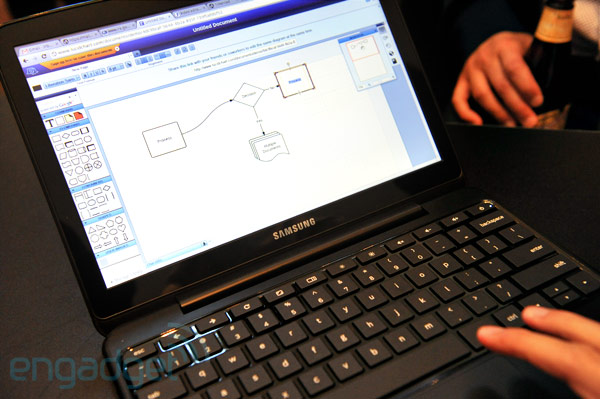
Rumors told us what, when and even how much to expect, but Google just made it official on stage -- Chrome OS netbooks are finally here, and Samsung is leading the way with a ultra-slim 0.79-inch thin machine. This is the Samsung Series 5 ChromeBook, which plays to Google's new standard "Chromebook" spec --in short means they'll each come with a dual-core Intel Atom processor and an "all-day" battery, which Google says will provide 8.5 hours of continuous usage here. Samsung's particular clamshell will have a 12.1-inch, 1280 x 800, 300 nit screen, weigh 3.26 pounds and come with dual-band 802.11 WiFi, optional global 3G, two USB 2.0 ports, an HD webcam and a clickable trackpad that Google tells us has thankfully been revamped since the CR-48. You'll be able to order one from Amazon or Best Buy beginning June 15th. It'll cost $429 for the WiFi version and $499 for worldwide 3G -- which includes 100MB of free Verizon data per month, just like the CR-48. PR after the break.
Update: Amazon's Series 5 listing details some additional specs -- we're looking at a dual-core 1.66GHz Intel Atom N570 chip, a 1 megapixel webcam, and a 16GB mSATA solid state drive here, as well as an SDXC card reader, and VGA-out via an "optional" dongle. The press release also mentions a Li-ion battery good for 1,000 recharge cycles, though it doesn't mention what efficiency will be like after that.
We never had much doubt about what Samsung would be showcasing at tonight's finale event at Google I/O 2011, but now it's official -- the outfit's first-ever Chrome OS ultraportable is making its debut in San Francisco, and we've been fortunate enough to grab a bit of hands-on time. Slated to ship to consumers, businesses and educational institutions on June 15th, the 12.1-inch Series 5 is a strikingly svelte machine, and there's no doubt that holding a 0.79-inch rig gives us all kinds of chills. The company took a bit of time to play up its "Power Plus" battery technology, lasting up to 8.5 hours with "active use," or 5 hours of straight video. There's also a new hitch in the Verizon Wireless data deal -- 100MB will be tossed in each month on the 3G model, but contrary to what we'd heard earlier, that ends after two years (rather than lasting for the life of the product).
The hardware feels tremendous -- stiff, solid and well appointed, much like Samsung's Galaxy Tab 10.1 Limited Edition. It outclasses the other sub-$450 netbooks we've seen in both style and rigidity, and while we'll always have a special place in our heart for the CR-48, it's pretty clear that this particular unit was in the oven for some while. We've hoping to spend some serious time with this guy in the middle of next month, but for now, here's what we can tell you -- the 1280 x 800 display is both crisp and sharp, with shockingly great viewing angles for a machine of this price. The keyboard's far from cramped, and if you've had your doubts on the 12.1-inch form factor, we're guessing one touch of this would have those running for cover. Oh, and the trackpad? One of the best we've felt in the PC universe, and one that we hope crops up elsewhere in the near future. It's right about on par with the one found on the CR-48, which is also stellar compared to most netbooks.
Obviously, we aren't here long enough to test the ultra-longevous battery (said to be good for over 1,000 cycles -- perfect for education and business users who are apt to adopt it), but we'll be sure to do our best once we settle down with a production unit. We're told that it'll be available in Titan Silver or Arctic White, provide a chiclet style keyboard, a multi-gesture trackpad (which supports two-finger scrolling) and "instant" wake from sleep. For now, head to the gallery for more eye candy, and check back momentarily for video!
Tweet
Our team was lucky enough to stumble into some cute little robots while roaming around at Google I/O today. What we have here is a little hands-on video of Hasbro’s Robot Toys that are being powered by a Google Nexus S. These robots are walking around at will, no talking yet though. Hasbro and Google have been working hard to get these little guys working together so we got a little hands-on time until one has a little “accident”.
What they have done is built a body-like dock that is self powered with its own battery that connects to the Nexus S via bluetooth. They have integrated servo’s for movement and motion. What makes this unique is they are not just reacting to a few commands to walk around. They are observing the environment using the front facing camera and different phone sensors and the touchscreen. Then actually connect to Google’s new facial and object recognition platform via the Google Cloud and this is how they react to surroundings and walk towards or away from objects. Pretty neat idea.
You can shake them to make them dizzy, or rub the touchscreen to make them happy. For now Hasbro stuck to simple Male and Female robots but we expect more to come. They can even take a photo using the front facing camera if needed, recognize something they don’t like and they will try to run away but might not get very far if they aren’t as fast as the robot in our hands-on. Poor guy just didn’t have the legs to finish the race, Plop! For now these are only prototypes and are a work in progress, in case you didn’t notice by the video or my comments above. Check out the video below and make sure you watch to the end.
Along with many other things as of late, Google just tipped everyone off about another great change coming to the Android Marketplace. The change I’m talking about today is application size. Currently applications in the market are limited to 50MB. In general this is a pretty large size for most apps and has worked great for a long time, but with the ever changing technology and games getting bigger and better along with hardware such as the Tegra 2 dual-core chip, games and applications have also increased in size.
the 50MB limit we have now was fine until we started getting more intense games and graphic enhancements. Today Google announced they are increasing this to 4GB, a huge increase in app size limit. This will eliminate almost all secondary installs. Like when you download Gun Bro’s but then start the app only to find out you need to download an additional 150mb of data to the SD card. This issue will be gone once the 4GB limit is included.
This is just one of many changes coming to the Android Market, another thing Google mentioned today was the option for developers to “exclude” or blacklist devices from installing their particular app. So when a developer doesn’t support a certain device yet, or an older phone they can simply blacklist that model so users wont install it only to have issues later that blow up his email account. These are great things to come for both users, and developers.
Looks like Android just keeps getting bigger and bigger, not to mention better with every release and will surely be very exciting once Ice Cream Sandwich launches. According to new numbers from the live sessions at Google I/O Android Market application installations has seen an extremely rapid growth of installs.
From the image shown above, clearly Android has taken off to new heights over the past year or so. Just in 2010 application installations from the market was over 8 times as many as 2008 and 2009 combined. That is huge growth, and we have been seeing plenty of reports about this lately.
From the charts above, shown at Google I/O this morning, Android has clearly not slowed down one bit in the application installs category. It looks like they are more than full speed ahead. Android Market application installs in 2011 has almost passed all of 2010 in just Q1 of 2011 alone. Showing that things are moving along just fine to say the least. By the end of Q2 2011 installs will have completely passed all of 2010, and by the end of 2011 things will surely be off the chart.
With Android 3.1 tablets starting to take off, and all the exciting phones on the way this summer in the U.S. and from multiple carriers across the world 2011 will be another huge year. I can’t even begin to imagine where we will be, and how amazing hardware will look by December. With the ever growing and changing market things will surely be exciting. Stay tuned for more from Google I/O.
Lets begin this chat by noting that they certainly did not say a whole heck of a lot. At the first hour-long keynote speech of the conference, Google whipped through a plethora of news bits, Ice Cream Sandwich certainly not the one winning the attention contest. The greatest moment was the reveal of the excellent logo mark that’ll be coming along with the update to Android, it and the name being a metaphor for exactly what the new system would be doing for the mobile OS: integrating it. Sandwiching it, if you will. It’s going to be oh – so – tasty.
The words were released from Google Product Manager, Hugo Barra’s mouth, that the “most ambitious release yet” would be coming in Ice Cream Sandwich form and that this update would not only act as a tie for all screen sizes, those on handsets, tablets, Google TV, and the lot, but that it would make for a much easier world for developers to live in. A single API framework for what may be the easiest Android version to develop for yet. No more Honeycomb specific apps for you!
“We want one OS that runs everywhere.”
That’s what Mike Claren of the Android engineering team said whilst presenting this version of the OS for the first time during the first keynote at Google I/O 2011. One of the first big points Claren had on making this one OS a possibility for developers is that Google would be taking the “state of the art” features as created for Honeycomb, UI improvements especially, and bringing them to the entire platform, for all devices. This includes new holographic UI, multitasking UI, launcher, richer widgets, advanced applications, and everything in-between.
And what’s best? This new version of Android wont have any new hardware requirements. That means it’ll be able to work on older handsets galore!
Claren went on to note that Google is investing heavily in what he called an Advanced App Framework. This means insulating developers from the differences in all of the different devices Android can be run on, so Google is adding new API to the framework to help all you developers out there scale your user interfaces across all the different sized screens and devices toting them. New components are being added to the Action Bar (the one you see in Honeycomb) that’ll be able to reconfigure themselves to work with whatever space is available to them.
On top of THAT, more energy is being put into developing tools (the talk about this specifically being done on the 11th of May at 3PM PST, for those keeping track,) and of course, without even thinking about it everyone should have already known – Ice Cream Sandwich will be open source.
For Ice Cream Sandwich (or perhaps before it, Claren isn’t too specific,) are the following new features: Developed by Google’s Technology Extraction Team in Roswell New Mexico — weird? Claren says it’s totally true – wild, crazy! The first element is thus:
Head Recognition Software
This technology can detect your head, not just your face, recognizing not only where your head is, but where you’re looking. This tech runs on the GPU, this currently meaning that it’ll work at 500 frames per second – quick! This tech is demonstrated by Anand Agarawata who shows off a white tablet with several objects on it displayed on the screen of a Motorola XOOM tablet moving in accordance with his head. Wacky!
Eyes, Nose, and Mouth Recognition Software
In another demonstration by Anand on the XOOM, a button is pressed for mouth, nose, and eyes, one by one, expanding each of them in turn instantly, transmitting the image to the screen via a mirror sort of situation. Basically just a piece of candy for now, but you can see the possibilities, I’m sure.
Virtual Camera Operator
This app, or functionality, or whatever you’d like to call it at this point, is able to detect a person speaking in a video that the device its on is recording and focus on them. What does that mean? Anand and his good pal Hugo Barra, (Product Management Director for Android,) demonstrate this functionality by both speaking into the front-facing camera of the Motorla XOOM. When either of them speaks, the camera zooms in on that person relatively smoothly, then back to whoever is speaking next in turn.
Tweet
The first and undeniably most action-packed keynote from Google I/O 2011 is up now, covering what Google is calling their three Ms. In Momentum, they spoke about the power and speed of Android in how well it’s doing in the world today, everything from 100 million activations and 4.5 billion installs of apps. Next in Mobile, they covered the newest upgrade for Android, version 3.1, the next step in Honeycomb for tablets and Google TV, Ice Cream Sandwich aka “one Android release everywhere,” and more. The list continues and the video is up!
The next big item they went over today was Movie Rentals. You’ll soon be able to rent movies from the Android Market at will, watching whatever you want from whatever device you want to watch it on. Along those same lines is Music Beta, a whole music platform which, if you’d like to know more, you can check out in our entirely full guide and deep dive. Media in the cloud!
Google went on to speak about Android Open Accessory, a partnership between Google and the rest of the industry that’ll guarantee the newest updates to all Android devices 18 months into their lifespan. Android Open Accessory was spoken about for a brief period and Android@Home for all manner of devices and applications for your own personal environment. Light switches!
Behold the entirety: